ScanQueue
An AI radiology worklist that flags suspected critical findings on incoming CT, MR and X-ray studies and orders every read by acuity and SLA — so the sickest patient is read first, not FIFO.
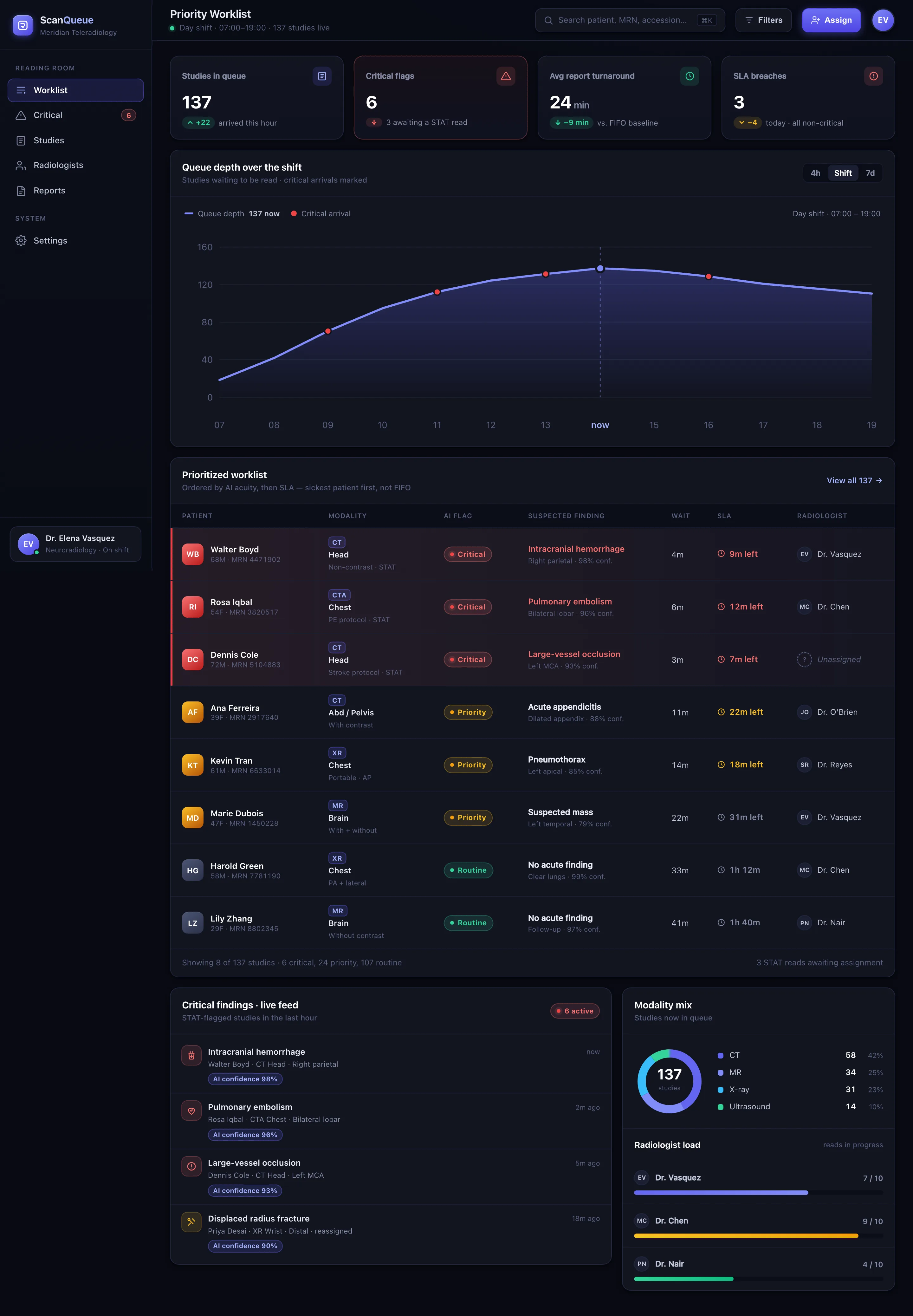
// The priority worklist — queue-depth over the shift, critical-flag KPIs, and an acuity-ordered table where the sickest patient is read first, not FIFO.
Figures from the engagement, shared under NDA.
We publish them unchanged and can’t break them down any further here. The reference build you can open runs entirely on sample data.
If you read one part of this page, read these 4 lines.
- Reads the sickest patient first — critical findings jump the queue instead of waiting behind routine films
- Every study carries an acuity rank and a live SLA countdown, so nothing quietly breaches
- Radiologist-in-the-loop: the AI orders the list, the physician reads and signs every study
- One reading-room view of queue depth, critical findings and turnaround for the whole shift
What it does — and which part of it we built.
ScanQueue gives a reading room an acuity-first worklist instead of a first-in-first-out queue.
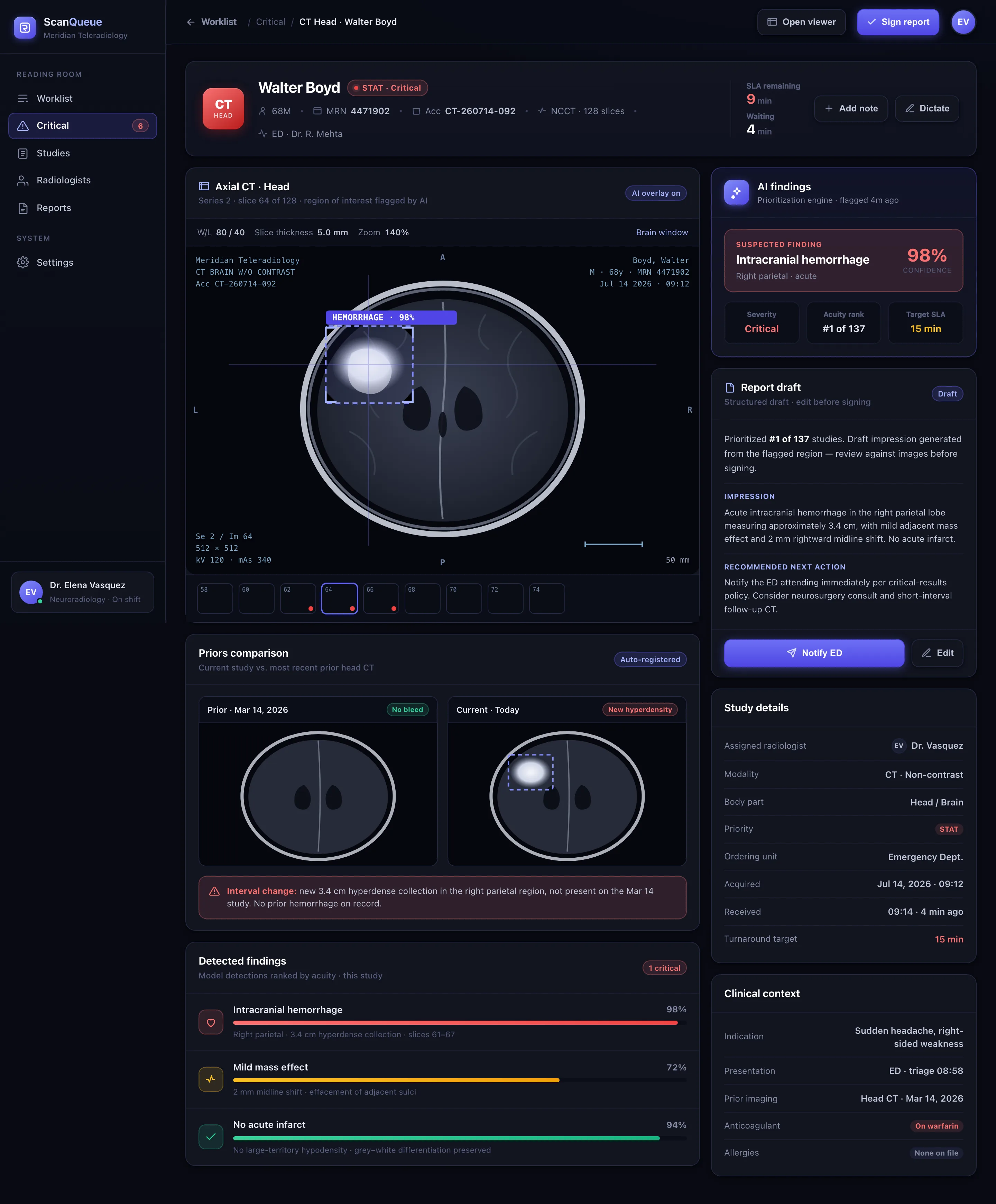
As imaging studies arrive, the AI reads each one, flags suspected critical findings — intracranial hemorrhage, pulmonary embolism, large-vessel occlusion, pneumothorax — for a STAT read, and re-orders every radiologist's list by acuity and SLA. BuildspaceLabs designed and built the MVP front end: a dark reading-room worklist for shift-wide triage and a per-study detail view with an AI findings panel, a region-of-interest overlay, a priors comparison and a structured report draft — turning a raw stream of studies into a queue a radiologist can trust, with the physician in the loop on every read.
Every screen here is from the reference build, not the client’s system.
The captions say what you are looking at. Every name and record on them is sample data.
What the engagement left the client with.
- Delivered a production-quality MVP of the priority worklist and study detail view in a 10-week engagement
- Cut average report turnaround by moving from first-in-first-out to acuity-and-SLA ordering
- Consolidated detection, prioritization and reporting into a single reading-room surface
- Established a reusable dark reading-room design system (acuity pills, SLA countdowns, ROI overlays) for the product's next screens
The stack was picked per constraint, not per house habit.
7 technologies across 3 layers — the shape of the stack follows the problem.
Every feature in the build (6)
- Priority worklist ordered by AI acuity and SLA, with live queue-depth, critical-flag and turnaround KPIs
- Critical-finding detection for CT, MR and X-ray, each flag carrying a confidence score
- Live SLA countdown per study so emergent reads never quietly breach their window
- Study detail with an AI findings panel — suspected finding, confidence and severity
- Region-of-interest overlay and auto-registered priors comparison flagging interval change
- Structured report draft with a recommended next action — the radiologist edits and signs
Don’t take our word for it — it is running in the frame below.
This is the same page the provenance block links to: our reference build for ScanQueue, with its own look, copy and motion. Scroll inside it, or open it full-screen.
// next
Building something in this space?
A 30-minute call is enough for us to understand your situation and tell you whether we're the right team. Usable version in the first two weeks if we are.